Cabinet fundamentals
Plywood cabinet boxes: what to look for beyond the label
Good Measure Cabinet Co. 3 min read
A closer look at cabinet panels, drawer joinery, shelves, and everyday hardware.
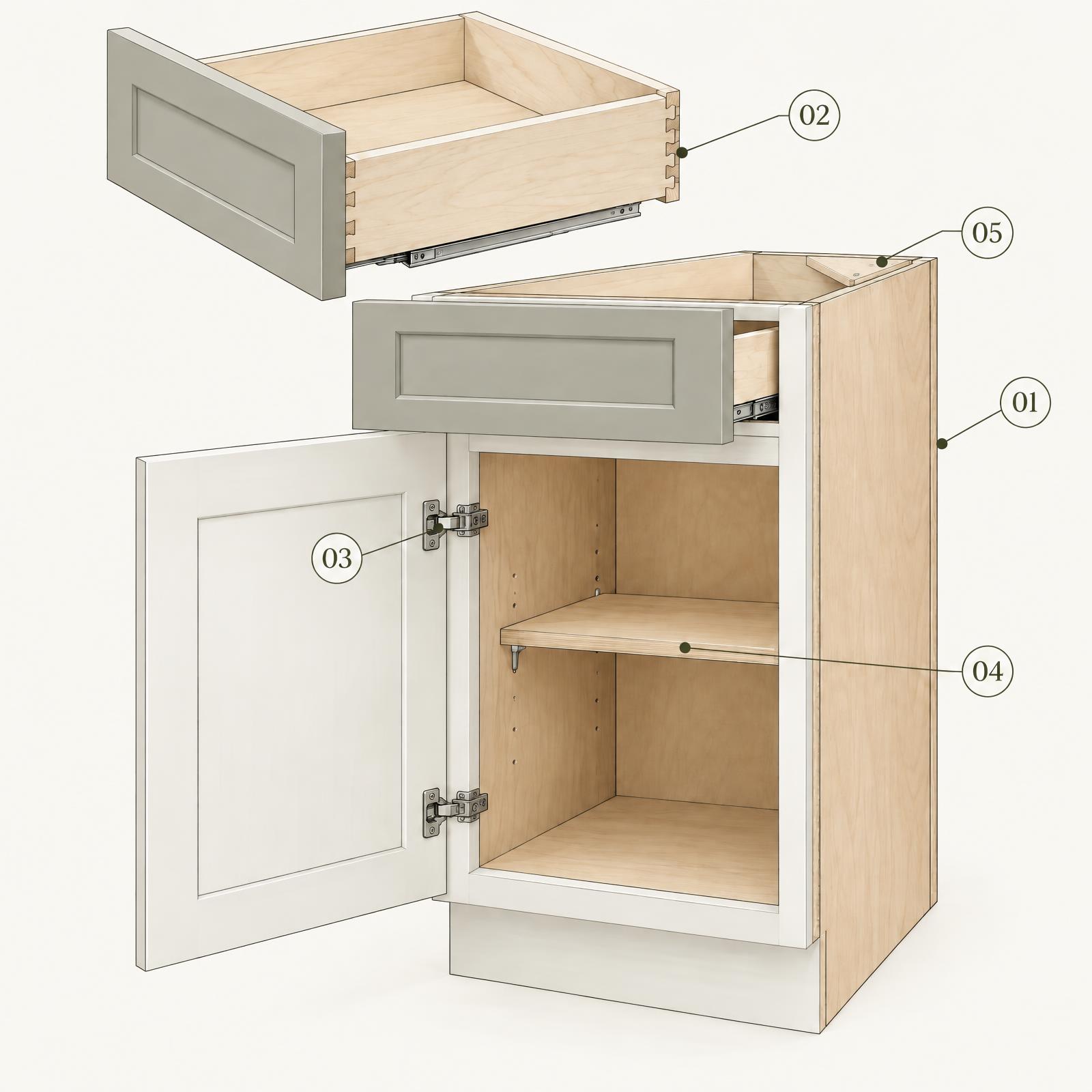
“Plywood cabinets” is a useful starting point, but it is not a complete specification. A kitchen cabinet is a collection of parts, each doing a different job. The box supports the assembly, the shelves carry what you store, and the drawers and hinges handle repeated movement. Instead of judging quality by one material label, ask how the cabinet is built and what is included in the actual product you are considering.
Ask which parts are plywood
Plywood uses layers of wood veneer bonded together; particleboard uses bonded wood particles. Those names describe materials, not the quality of every finished cabinet made from them. Compare the specific panels and construction details in each proposal. Our Signature framed cabinetry has ½″ plywood cabinet panels with a UV clear coat. That is a concrete specification you can compare, rather than an undefined claim that every component is “all wood.”
Check the front structure and reinforcement
Our cabinet boxes are paired with a ¾″ solid wood face frame. Solid wood corner brackets help keep the cabinet square and add stability. These details work alongside the panels rather than replacing them. Ask how a cabinet is assembled and supported, and remember that correct installation matters too. A product description cannot account for the actual wall, floor, or site conditions in your home.
Open the drawer in your comparison
Our drawers use ⅝″ solid wood boxes with dovetail joints and a ⅜″ plywood bottom. Joinery, bottom construction, and slide hardware are separate details worth checking. Full-extension soft-close slides make the contents easier to reach and soften the final closing movement. If another proposal simply says “wood drawers,” ask for the box material, joint type, bottom specification, and hardware information before treating it as equivalent.
Do not overlook the shelves
A shelf is one of the hardest-working parts of a cabinet. Our adjustable shelves are ¾″ plywood, with birch veneer on the top and bottom and a banded front edge. Adjustable positions help the interior suit dishes, pantry items, or taller containers. That flexibility is useful, but it is not a reason to assume unlimited loading capacity. Follow the applicable product and installation guidance for how each cabinet should be used.
Bring material questions into the layout conversation
There is no need to choose between a good-looking kitchen and a detailed specification. Review the door finish, box construction, drawers, and shelf arrangement together. On our Cabinetry page, a numbered illustration connects the construction details to the cabinet itself. We can also talk through how those features relate to your storage needs. Neither a floor plan nor a technical vocabulary is required to ask your first question.